
Capacitor Types Explained: From Ceramic to Electrolytic Capacitors
Capacitors are a fundamental component of almost every electronic equipment. Cell phones, industrial machinery, etc.
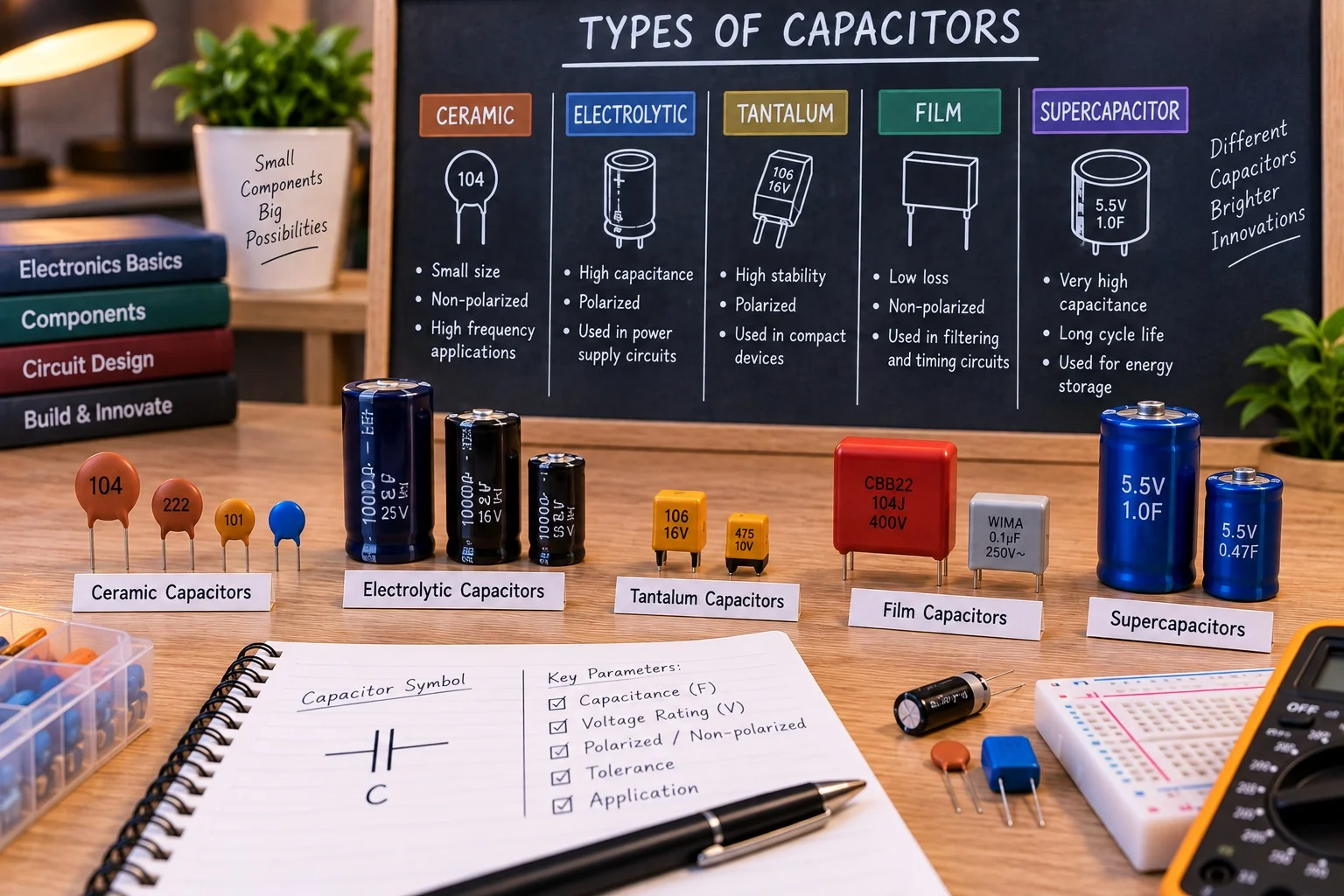
Table of Contents
Introduction-
Capacitor Types Explained are a fundamental component of almost every electronic equipment. Cell phones, industrial machinery, etc., depend on them to carry electric current through a circuit and disengage it when needed. They can be used to perform a variety of objectives, including smoothing out voltage spikes, acting as filters, and delivering jolts of power. Knowing the different types of capacitors is necessary in order to choose the best one to be used in your project. So in this paper, we will discuss various types of capacitors, their functions, and applications.
What is a Capacitor?
A capacitor is a passive electronic component that stores energy within an electric charge. It consists of two conductive plates separated by an insulating material referred to as the dielectric. Upon application of a voltage on the capacitor, the electrons accumulate on one plate and create a difference in charge between the two plates. The energy can be released on demand; therefore, capacitors are of vital importance in power management and signal processing.
How Do Capacitors Work?
Capacitors are charge storage devices based on storing electrical energy in an electric field between the plates. Current flow and charge of the plates can be present when a DC voltage is applied across them, but once it's fully charged, the capacitor won't let any additional DC current pass, but the AC signal may pass, making it useful for filtering applications. Capacitors can be pretty useful to smooth out the voltage and can be used for storing energy for later usage.
The basic formula for a capacitor’s capacitance (measured in farads, F) is:
C=QVC = frac{Q}{V}C=VQ
Where:
C is the capacitance,
Q is the electric charge stored, and
V is the voltage across the capacitor.
Varieties of Capacitors
There are several varieties of capacitors and each of these have their unique applications. The different types are determined by the different kinds of materials used as well as how the capacitors are made. In this chapter we shall discuss the most commonly used of these.
By virtue of their versatility and minute size, ceramic capacitors are one of the largest varieties of capacitors in current usage. They contain ceramic dielectric material and come in two forms, namely, multilayer ceramic capacitors (MLCC) and single-layer capacitors.
Capacitance Range: Typically from a few picofarads (pF) to several microfarads (µF).
Voltage Rating: Ranges from low to high voltage, often up to several hundred volts.
Applications: Used in filtering, decoupling, and timing applications.
Advantages:
Low cost and compact size.
High stability and reliability.
Wide capacitance range.
Disadvantages:
Lower capacitance compared to other types.
Limited tolerance to high voltage in some cases.
Electrolytic capacitors are polarized capacitors. That is, they have both a positive and a negative terminal. They use an electrolyte as the dielectric. Therefore, for a similar volume, a higher capacitance value can be achieved. Hence, these capacitors are usually used in applications requiring heavy energy storage.
Capacitance Range: Ranges from 1 µF to thousands of µF.
Voltage Rating: Typically between 6V and 450V.
Applications: Commonly used in power supply circuits, audio circuits, and voltage filtering.
Advantages:
High capacitance in a compact form.
Suitable for use in low-frequency circuits and power supply filtering.
Disadvantages:
Limited lifespan, especially when exposed to high temperatures.
Polarized, so incorrect installation can cause failure.
Tantalum Capacitors
Tantalum capacitors are electrolytic capacitors that feature an anode of the metal tantalum. Tantalum capacitors are highly prized for their high capacitance per volume, as well as their excellent long-term reliability.
Capacitance Range: From a few µF to several hundred µF.
Voltage Rating: Typically between 2V and 50V.
Applications: Used in space-constrained applications, such as mobile phones and other portable electronics.
Advantages:
Compact size with high capacitance.
Stable performance and reliability.
Disadvantages:
More expensive than aluminum electrolytic capacitors.
Susceptible to damage if exposed to high voltage spikes.
Film Capacitors
Film capacitors employ plastic films as the dielectric, and these capacitors are recognized for their precision and stability. These capacitors are available in a range of shapes and sizes; it depends on the material used.
Capacitance Range: From a few pF to several µF.
Voltage Rating: Can handle high voltages, up to several kilovolts.
Applications: Used in high-frequency applications, timing circuits, and power supply filtering.
Advantages:
Excellent stability and long life.
High insulation resistance and low self-inductance.
Disadvantages:
Bulkier compared to ceramic capacitors with similar ratings.
Supercapacitors
Supercapacitors, also known as ultracapacitors, store much more energy than conventional capacitors and are used where rapid charging and discharging is needed.
Capacitance Range: From hundreds of farads (F) to thousands of farads.
Voltage Rating: Typically low, around 2.7V to 5.5V per cell.
Applications: Used in energy storage systems, regenerative braking systems, and backup power supplies.
Advantages:
Extremely high capacitance and fast charging/discharging cycles.
Long cycle life.
Disadvantages:
Lower voltage limits, requiring multiple capacitors in series for higher voltage applications.
Higher cost compared to other capacitor types.
Applications of Different Capacitor Types
Capacitors play a critical role in various electronics and electrical systems. Here’s how different types are applied:
Ceramic Capacitors: For applications in Digital circuits for noise removal and timing elements in oscillators.
Electrolytic Capacitors: To filter out voltage ripples of power supplies and energy storage with amplifiers.
Tantalum Capacitors: Portable electronics where space is limited, such as smartphones.
Film Capacitors Used in snubbers within high voltage power circuits for audio applications where precise signal accuracy is neede.
Supercapacitors: Energy harvesting, memory backup power, etc. that requires fast energy delivery.
How to Choose the Right Capacitor
Selecting the right capacitor for your project depends on several factors:
Capacitance Value:
Determine what value of capacitance is needed for the circuit requirements. The uses of capacitors include storing energy, filtering and as timers.Voltage Rating:
Use a capacitor whose maximum voltage rating is more than the maximum voltage in your circuit. Normally, capacitors are chosen such that the rating is at least 20 % higher than the operating voltage to ensure safety.Temperature and Environment:
Think of the operating temperature range and environment. For instance, electrolytic capacitors are known to reduce life much more drastically when operated in high temperature conditions. On the other hand, ceramic capacitors tend to be more robust in terms of conditions.Size Constraints:
Size is a major issue in compact designs, such as in portable electronics; therefore, they opt for smaller types, like the tantalum capacitors or multilayer ceramic capacitors (MLCC).
Conclusion
Capacitors are an indispensable part of electronic circuits, providing functions ranging from energy storage to signal filtering. The choice of the correct type of capacitor will depend on learning about each one. Of course, each has its strengths and weaknesses, so matching the right capacitor with project requirements is worthwhile.
Tagged